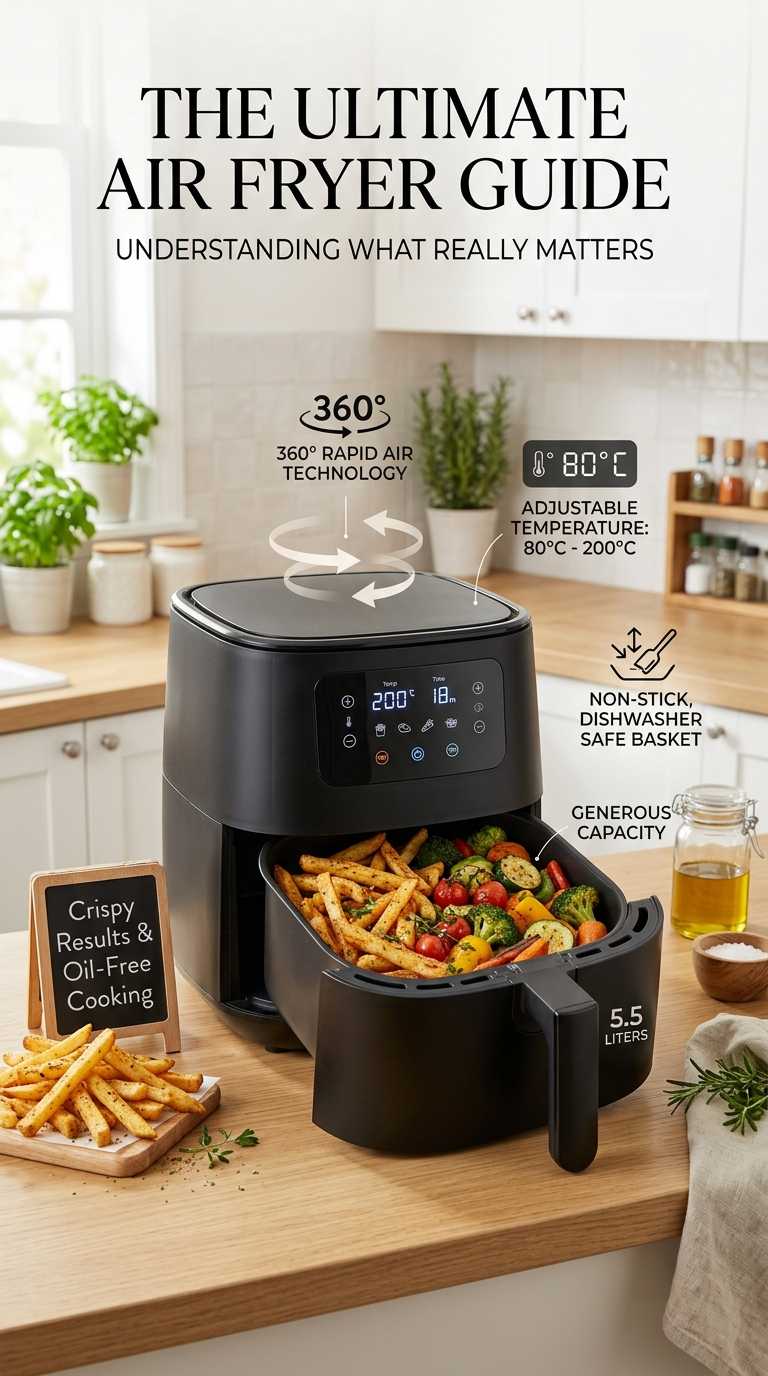
Air fryers have moved from being a trendy countertop gadget to a regular part of many kitchens. They can crisp frozen foods, roast vegetables, cook chicken, reheat leftovers, and handle a surprising range of everyday meals without the need for a large amount of cooking oil.
But choosing the right air fryer can be confusing. Capacity, wattage, presets, smart controls, temperature ranges, dual baskets, and accessories all compete for attention. More features do not necessarily mean better cooking.
The better approach is to focus on the things that affect your everyday experience: cooking performance, usable capacity, airflow, temperature control, cleaning, safety, and ease of use.
This guide explains what really matters when buying an air fryer and how to get better results once you bring one home.
How Does an Air Fryer Work?
An air fryer is essentially a compact convection cooker. A heating element produces hot air while a fan circulates that air around the food at high speed.
That circulation is what helps food brown and develop a crisp exterior. Unlike deep frying, the food does not need to sit in a large amount of hot oil. Depending on the recipe, you may need only a small amount of oil or none at all.
The compact cooking chamber also means an air fryer can heat up quickly. That makes it particularly useful for smaller meals when turning on a full-size oven would feel unnecessary.
It is worth remembering, though, that an air fryer is not a magic frying machine. Cooking results depend heavily on airflow, food arrangement, temperature accuracy, and cooking time.
What Matters Most When Buying an Air Fryer?
The best air fryer is the one that matches your cooking habits rather than the one with the longest feature list.
Start with the size and shape of the cooking area. Then consider how evenly it cooks, how easy the controls are to use, and whether the basket can be cleaned without a struggle. Features such as smart connectivity and extra presets should come later.
A good air fryer should make everyday cooking simpler. If a feature does not improve the way you actually prepare food, it may not be worth paying extra for.
Air Fryer Capacity: Look Beyond the Numbers
Capacity is one of the first specifications shoppers notice, but advertised liters or quarts do not tell the entire story.
What matters in practice is usable cooking space. A wide basket can sometimes be more useful than a deep one because many foods cook best when spread out rather than stacked.
For one or two people, a compact model can be convenient and easy to store. Larger households may need more cooking space to avoid preparing several batches.
If you regularly cook a full meal for several people, consider a larger basket or dual-basket design. However, remember that bigger appliances also require more counter space.
Before buying, think about the foods you normally prepare. A basket that comfortably fits your usual portions is more valuable than a large capacity figure that looks impressive on the product box.
Cooking Performance and Airflow Matter More Than Maximum Temperature
It is easy to become distracted by claims about extremely high temperatures. While temperature range matters, it does not determine cooking quality by itself.
An air fryer needs to circulate hot air effectively and maintain reasonably consistent heat. If airflow is poor, food may brown on top while remaining soft underneath.
This is why basket design matters so much. Vented or perforated surfaces can help hot air reach more of the food. A spacious basket also makes it easier to avoid overcrowding.
Good airflow is especially important when cooking fries, potato wedges, breaded foods, and vegetables where crispness is part of the appeal.
Why Overcrowding Causes Uneven Cooking
One of the most common air fryer mistakes is filling the basket too heavily.
When food is packed together, hot air cannot move freely around each piece. Moisture also has less opportunity to escape. Instead of crisping, food can steam in its own moisture.
If your food repeatedly comes out pale or soft, overcrowding should be one of the first things you check.
Try spreading food into a more even layer and cooking a second batch if necessary. For smaller foods such as fries or vegetables, shaking the basket partway through cooking can also redistribute pieces and expose more surfaces to the circulating air.
Temperature Control and Cooking Accuracy
A useful air fryer should give you enough control over temperature and cooking time for the foods you prepare most often.
Digital controls can make precise adjustments easier, while traditional dials offer a simple, straightforward experience. Neither approach is automatically better.
What matters is whether you can quickly set the temperature you need and make adjustments while cooking.
Keep in mind that two air fryers set to the same temperature may not cook identically. Differences in heating elements, airflow, basket design, and food placement can affect results.
For that reason, treat recommended cooking times as starting points. If food consistently finishes too early, reduce the cooking time. If it remains undercooked, check the basket arrangement and make small adjustments rather than immediately assuming the appliance is defective.
Are Air Fryer Presets Worth It?
Presets can be helpful, especially when you are learning how the appliance behaves.
A model might include programs for fries, chicken, fish, vegetables, baking, or reheating. These settings provide a convenient starting point without requiring you to remember temperatures and times.
However, presets are not a substitute for judgment.
A preset cannot know whether you are cooking a small handful of food or filling the basket. It also cannot account perfectly for different food thicknesses or starting temperatures.
If you regularly cook from scratch, reliable manual controls may be more valuable than a long list of automatic programs.
Basket Design and Ease of Cleaning
The cooking basket has a surprisingly large effect on everyday satisfaction.
A good basket should provide enough space for airflow and should be easy to remove, load, and clean. Complicated corners and narrow gaps can make grease and crumbs difficult to reach.
Dishwasher-safe components can make cleanup easier, although you should always check the manufacturer’s care instructions.
The type of nonstick coating is another consideration. Whatever coating a model uses, avoid abrasive cleaning methods or utensils that the manufacturer says could damage the surface.
Cleaning the basket after regular use is worthwhile because old grease and food residue can create unpleasant odors and smoke during later cooking.
Is a Viewing Window Useful?
Some air fryers include a viewing window that lets you watch food while it cooks.
It can be convenient because you do not need to pull the basket out repeatedly to check browning. That can reduce heat loss and make it easier to monitor foods that cook quickly.
Still, it is a convenience feature rather than a deciding factor. A well-designed basket, dependable temperature control, and good airflow are more important.
If two otherwise similar models are available and one has a useful viewing window, it can be a worthwhile bonus. It should not outweigh fundamental cooking performance.
Does Air Fryer Wattage Matter?
Wattage tells you how much electrical power the appliance is designed to use, but higher wattage does not automatically mean better cooking.
Performance also depends on heating-element design, cooking-chamber size, insulation, airflow, and temperature regulation.
A high-powered appliance may heat quickly, but it may also consume more electricity. Meanwhile, a lower-powered model can still perform well if its cooking chamber and airflow are efficiently designed.
Instead of chasing the highest wattage, choose a model whose power requirements suit your kitchen and whose size matches your typical meals.
Air Fryer Safety Features to Look For
Safety should be part of the buying decision, particularly because an air fryer produces substantial heat during operation.
Automatic shutoff and overheat protection are useful safeguards. A secure basket, stable base, and heat-resistant handle also make everyday operation easier.
Placement matters just as much as built-in safety features. Keep the appliance on a stable, heat-resistant surface with adequate clearance around ventilation openings. Do not block the vents or place the appliance in a confined area while it is operating unless the manufacturer specifically allows that setup.
If you notice unusual smoke, persistent burning smells, damaged electrical components, or other unexpected behavior, stop using the appliance and consult the manufacturer’s guidance rather than continuing to experiment.
Single-Basket vs. Dual-Basket Air Fryers
A single-basket air fryer is usually the simplest option. It works well if you mainly prepare one type of food at a time or prefer straightforward cooking.
Dual-basket models are more useful when you often prepare two foods simultaneously. You might cook vegetables in one compartment and a protein in the other, using different settings for each.
Some models can coordinate the cooking times so both foods finish together.
The trade-off is size. Dual-basket air fryers generally occupy more counter space, so they make the most sense when the additional flexibility will genuinely be useful.
Smart Air Fryers: Useful Upgrade or Unnecessary Extra?
Connected air fryers can offer smartphone controls, cooking notifications, recipe guidance, and other smart features.
These functions may appeal to people who enjoy connected kitchen appliances, but they are not necessary for good air frying.
If you are deciding between a smart model with mediocre cooking performance and a simpler model with better airflow, basket design, and temperature control, the simpler appliance is usually the more sensible choice.
Smart features should complement good cooking performance, not replace it.
What Can You Cook in an Air Fryer?
The versatility of an air fryer is one of its strongest advantages.
Frozen foods are an obvious starting point, but the appliance can also handle fresh vegetables, chicken, fish, potatoes, snacks, and many reheating tasks.
Vegetables can develop browned edges with a small amount of oil. Chicken can become nicely browned when cooked correctly, while fish can be prepared relatively quickly because the compact cooking environment heats efficiently.
Air fryers are also excellent for reheating certain leftovers. Pizza, roasted potatoes, and breaded foods often regain more texture in an air fryer than they would in a microwave.
The key is to adjust cooking time based on the food rather than assuming every recipe follows the same formula.
Common Air Fryer Problems and How to Fix Them
Food Is Not Crispy
If your food is coming out soft, first check whether the basket is overcrowded. Excess moisture and restricted airflow are common causes.
Spreading food into a thinner layer allows hot air to reach more surfaces. A small amount of oil can also improve browning for foods that benefit from it.
Food Is Cooking Unevenly
Uneven cooking can result from inconsistent food sizes or poor air circulation.
Cut foods into reasonably similar pieces where practical, avoid stacking them too heavily, and shake the basket during cooking when appropriate.
If the problem continues, inspect the basket and ventilation areas for buildup that could be affecting airflow.
Food Burns Before It Finishes Cooking
A very high temperature can brown the outside before the center has finished.
Try reducing the temperature slightly and extending the cooking time. This gives heat more time to reach the inside without aggressively browning the exterior.
For thick foods, always check that they have reached a safe level of doneness rather than relying solely on appearance.
The Air Fryer Produces Excessive Smoke
Smoke can occur when grease or residue is exposed to high heat.
Clean the basket and cooking chamber according to the manufacturer’s instructions. Also check whether particularly fatty foods are releasing more grease than usual.
If smoke continues despite proper cleaning, stop using the appliance and investigate the manufacturer’s troubleshooting guidance.
How to Choose an Air Fryer for Your Kitchen
Think about your routine rather than buying based on specifications alone.
If you mainly cook small portions, a compact model may be easier to use and store. If you regularly feed a family, additional cooking space can reduce the need for multiple batches.
If you like preparing two foods at once, a dual-basket model may justify its larger footprint. If simplicity matters most, a straightforward single-basket air fryer may be the better choice.
Also measure your available counter space before purchasing. An appliance that technically fits but leaves little room for ventilation or everyday use can quickly become inconvenient.
Features Worth Paying More For
Some upgrades can genuinely improve your experience.
Reliable temperature control, effective airflow, durable construction, an easy-to-clean basket, and a cooking area that suits your household are all worth prioritizing.
Additional cooking modes can also be useful if you will actually use them.
By contrast, an enormous number of presets, decorative displays, or smart features may not provide much value if your cooking routine is simple.
The best upgrade is one that solves a real problem.
Air Fryer vs. Oven and Deep Fryer
An air fryer does not completely replace every other cooking appliance.
Compared with a conventional oven, it is often more convenient for small portions because the cooking chamber is compact and heats quickly. An oven remains better for large dishes, multiple trays, and substantial meals.
Compared with deep frying, air frying requires far less oil and avoids handling a large container of hot oil. However, the texture may not be identical to traditional deep-fried food.
For many households, an air fryer works best as a complementary appliance rather than a complete replacement for the oven or stovetop.
Final Thoughts: What Really Matters in an Air Fryer?
Buying an air fryer does not have to involve comparing dozens of complicated specifications.
Focus first on the fundamentals: usable capacity, airflow, basket design, temperature control, cooking consistency, cleaning, safety, and countertop size. These factors will have a much greater effect on your everyday experience than a long list of extra features.
Once you have chosen a suitable model, remember that technique matters too. Avoid overcrowding the basket, give food enough room for air to circulate, shake smaller foods when appropriate, and adjust cooking times based on your results.
If your current air fryer struggles with uneven cooking, poor crisping, or difficult cleanup, try addressing those practical issues before assuming you need a replacement. On the other hand, upgrading can make sense when the appliance no longer provides enough capacity, has unreliable performance, or lacks features that would genuinely improve your cooking routine.
Ultimately, the best air fryer is not necessarily the biggest, most powerful, or most expensive one. It is the model that fits your kitchen, matches the food you actually cook, and makes everyday meals easier to prepare.