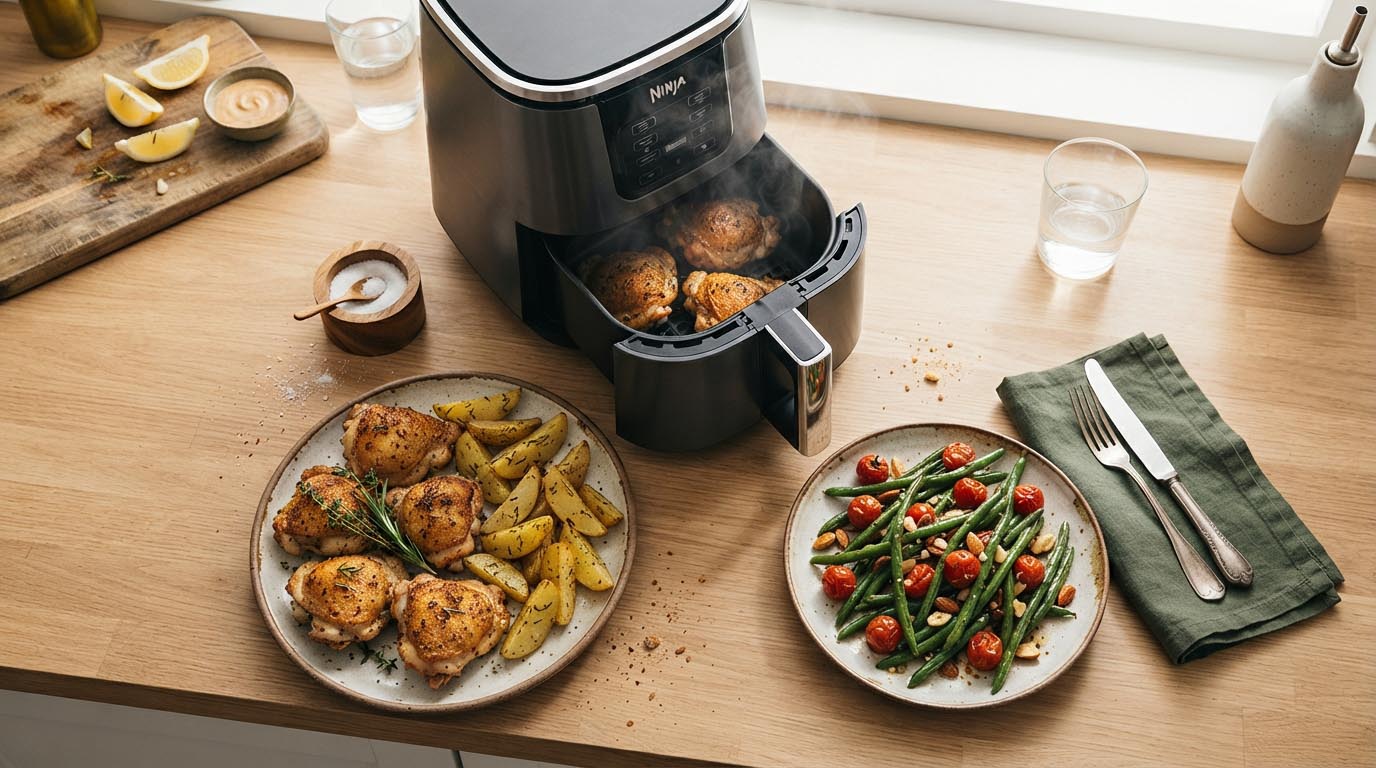
Most people buy an air fryer for fries and leftover pizza, then never push it much further. That’s a shame, because this compact countertop appliance works like a small, fast convection oven, and it can handle an entire dinner: a main dish, a side or two, and even something sweet. If you’re new to air frying and wondering whether it can really feed a whole family, the short answer is yes. You just need to understand how it cooks and how to schedule your dishes.
This guide covers how air fryers work, the habits that separate crispy results from soggy ones, three complete menus to start with, and fixes for the most common problems.
Why an Air Fryer Suits Busy Family Kitchens
An air fryer circulates very hot air around your food with a powerful fan, which crisps the surface much like deep frying does, only with a spoonful of oil instead of a pot of it. Because the cooking chamber is small, it heats up in a few minutes and cooks most foods noticeably faster than a full-size oven. That means shorter waits on weeknights, a cooler kitchen in summer, and less energy spent heating a big oven for a few chicken thighs.
Cleanup is another quiet advantage. Most baskets and trays are nonstick and many are dishwasher safe, so the post-dinner pile of dishes shrinks. And because the machine is so forgiving, beginners tend to get good results quickly, which builds confidence for trying more ambitious meals.
Getting to Know Your Machine
Before you cook anything, it helps to understand what kind of air fryer you own, because the type affects how much food you can make at once.
Basket Models vs. Oven-Style Models
Basket air fryers are the most common. They’re compact and quick, but the food sits in a single layer, so capacity is limited. Oven-style models, which have wire racks or multiple trays, give you more surface area and suit larger households or anyone who wants to cook a protein and a vegetable at the same time.
Choosing the Right Capacity
As a rough guide, a 4-quart unit comfortably serves one or two people, while 5 to 6 quarts works for a family of three to five. If you regularly feed more than that, look at 7 quarts or larger, or plan on cooking in batches. A bigger basket doesn’t help if you pack it full, since food needs space for air to move around it.
Learn Its Quirks
Every air fryer runs a little differently. Many cook hotter near the heating element, and the temperature on the dial isn’t always exact. For the first few meals, check your food a couple of minutes before the recipe says it should be done. Jot down what works, and you’ll soon know your machine better than any recipe does.
The Habits That Make Air-Fried Food Turn Out Right
Good air frying comes down to a handful of principles, and each one has a clear reason behind it.
Start with space. Crowding the basket is the single most common beginner mistake. Hot air has to reach every surface of the food to crisp it, and a packed basket traps steam instead, leaving you with pale, limp results. If your meal doesn’t fit in a single loose layer, cook it in two rounds. The second batch often finishes faster because the machine is already hot.
Moisture matters just as much. Water on the surface of food has to evaporate before browning can begin, so patting meat and vegetables dry with a paper towel gives you crispier edges in less time. A light coating of oil, about a teaspoon or two, helps heat transfer and encourages browning. Choose a high smoke point oil such as avocado or canola, and brush or toss it on rather than using aerosol sprays, since the propellants in some cooking sprays can degrade nonstick baskets over time.
Cut food into similar sizes so everything finishes together, and give smaller items a shake or larger pieces a flip about halfway through. Because the heat comes mostly from above, the underside of food can lag behind, and turning it evens things out. A brief preheat of three to five minutes also helps, especially for meat, since food hitting a hot basket starts browning right away instead of slowly steaming as the unit warms up.
Finally, trust a thermometer more than the clock. Chicken is safe at 165°F (74°C), ground meat at 160°F (71°C), and pork and fish at 145°F (63°C). Cooking times vary by model and thickness, so a quick temperature check is the only reliable way to know a dish is done without cutting into it.
How to Time a Full Meal
Cooking one dish is easy. Getting three dishes onto the table at the same time is where most beginners get stuck, and the secret is simply to cook in stages. Begin with whatever takes longest, usually the main protein or dense vegetables like potatoes. Once the protein is done, move it to a plate and tent it loosely with foil. Resting meat for about ten minutes keeps it juicy and holds its heat, which gives you a window to cook the sides in the same basket.
Quick-cooking items such as garlic bread, tortilla chips, or a dessert can go in last. If you have a conventional oven, keeping finished dishes warm at around 200°F (95°C) is another easy way to bridge the gaps when you’re cooking in batches.
Three Family Meals to Start With
The following menus are built around realistic timing, so each one flows from the first dish to the last. Treat the times as starting points and adjust to your machine.
A Crispy Chicken Dinner with Potato Wedges and Green Beans
This one serves four and is a great first full meal. Pat the chicken thighs dry, then rub them with a tablespoon of oil, salt, pepper, garlic powder, and paprika. Air fry at 380°F (190°C) for 22 to 25 minutes if bone-in, or 15 to 18 minutes if boneless, flipping halfway through. Let them rest under foil while you cook the sides.
For the potatoes, cut four medium ones into wedges and soak them in cold water for about 15 minutes. This pulls out surface starch, which helps the wedges crisp rather than turn gummy. Dry them thoroughly, toss with oil and seasoning, and cook at 400°F (200°C) for 18 to 22 minutes, shaking every six minutes or so. Green beans go in last, tossed with a little oil, salt, and minced garlic, for 6 to 8 minutes at 375°F (190°C).
Taco Night with Air-Fried Corn and a Sweet Finish
Taco night is easy to scale for four to six people. Season about a pound and a half of chicken breast strips with taco seasoning and a touch of oil, then cook them at 390°F (200°C) for 8 to 10 minutes, turning once. If you prefer beef, brown the ground meat on the stovetop and use the air fryer for everything else.
While the filling rests, brush corn on the cob with butter and cook it at 400°F (200°C) for 10 to 12 minutes, turning halfway so the kernels brown evenly. For dessert, cut flour tortillas into triangles, brush them with melted butter, and dust with cinnamon sugar. Three to four minutes at 350°F (175°C) turns them into crunchy chips that kids tend to fight over.
Lemon-Garlic Salmon with Broccoli and Sweet Potatoes
This lighter meal serves four and starts with the vegetable that takes longest. Cut sweet potatoes into three-quarter-inch cubes, toss them with oil, salt, and a pinch of cinnamon or smoked paprika, and cook at 400°F (200°C) for 15 to 18 minutes, shaking halfway. Set them aside and cook the salmon, seasoned with salt, pepper, garlic, and a squeeze of lemon, at 400°F (200°C) for 8 to 10 minutes. It’s ready when it flakes easily and reaches 145°F (63°C).
Broccoli finishes the meal. Toss it with oil, salt, and a pinch of chili flakes, then cook at 380°F (190°C) for 6 to 8 minutes, until the florets have crispy edges.
A Quick Reference for Common Foods
Once you’re comfortable with the basics, a cheat sheet makes it easier to improvise. This is one of the few places where a table genuinely helps, so keep it handy.
| Food | Temperature | Approximate Time |
|---|---|---|
| Boneless chicken breast | 380°F / 190°C | 14–18 minutes |
| Chicken drumsticks | 390°F / 200°C | 18–22 minutes |
| Pork chops (¾ inch) | 380°F / 190°C | 10–14 minutes |
| Meatballs | 380°F / 190°C | 8–10 minutes |
| Salmon fillets | 400°F / 200°C | 8–10 minutes |
| Shrimp | 400°F / 200°C | 5–7 minutes |
| Potato wedges or fries | 400°F / 200°C | 15–22 minutes |
| Broccoli or cauliflower | 380°F / 190°C | 6–10 minutes |
| Brussels sprouts | 380°F / 190°C | 10–12 minutes |
| Frozen chicken nuggets | 390°F / 200°C | 8–10 minutes |
Foods an Air Fryer Doesn’t Handle Well
An air fryer is versatile, but it has limits. Wet batters are the classic failure: because there’s no hot oil to set the coating instantly, the batter simply drips through the basket. Use a dry flour, egg, and breadcrumb coating instead. Leafy greens like spinach can fly around in the fan and scorch, and very large cuts such as whole turkeys won’t fit in most units. Heavy cheese toppings can also melt, drip, and smoke, so keep them light or add cheese only in the last minute or two.
Troubleshooting Common Air Fryer Problems
Even experienced cooks run into trouble now and then. The good news is that most problems trace back to a few simple causes, and understanding why a fix works makes it easier to apply it next time.
Why Is My Food Soggy Instead of Crispy?
Soggy results almost always mean steam is getting trapped. Either the basket is too full, or the food was wet when it went in. Spread the food into a single layer so air can reach every side, and blot it dry first. Crisping depends on moisture leaving the surface quickly, and a crowded or damp basket slows that process to a crawl.
Why Is the Outside Burnt but the Inside Raw?
This happens when the temperature is too high for the thickness of the food. The surface browns long before the heat can travel to the center. Drop the temperature by about 25°F and extend the cooking time slightly, which gives the interior time to catch up. With thick cuts, you can also cook at a moderate temperature first and finish with a hotter blast for color.
Why Does My Food Come Out Dry?
Lean cuts like chicken breast dry out quickly in a high-heat, fast-moving environment because there’s little fat to protect them. Shorten the cooking time, brush on a thin layer of oil, and pull the meat as soon as it hits the safe internal temperature. Switching to thighs, which contain more fat, is also a forgiving alternative.
Why Is My Air Fryer Smoking?
Smoke usually comes from fat dripping onto a hot surface or from old grease baked onto the heating element or drawer. When you cook fatty foods such as bacon, sausages, or burgers, add a small splash of water to the drawer beneath the basket. The water keeps drippings from reaching smoking temperature. Regular cleaning removes old residue that would otherwise burn and smell.
Why Is Parchment Paper Flying Around?
Lightweight parchment can lift in the fan stream and touch the heating element, which is a fire risk. Never preheat with loose parchment, and always weigh it down with food. Perforated liners made for air fryers are a safer choice because they let air flow through.
Making Meals for a Bigger Family
If you’re feeding a crowd, planning matters more than appliance size. Prepping ingredients earlier in the day, whether that means cutting vegetables or seasoning meat, turns dinnertime into an assembly line. Cooking in batches works well because air fryers recover heat quickly, and a low oven or foil tent holds finished food at a pleasant temperature. Racks, skewers, and silicone liners can also increase how much you cook at once. Pairing the air fryer with a pot of rice, pasta, or a simple salad keeps the workload balanced, so the appliance isn’t doing everything at once.
Cleaning Your Air Fryer So It Keeps Performing
Regular cleaning protects both flavor and function. Let the basket cool, then wash it with warm, soapy water and a soft sponge, or place it in the dishwasher if the manufacturer allows it. Wipe the inside of the unit with a damp cloth, paying attention to the area around the heating element, then dry everything thoroughly before reassembly. Leftover grease is what causes most smoking and stale odors, so a quick clean after each use saves you trouble later.
Is It Time to Upgrade Your Air Fryer?
Most people don’t need a new machine, but there are situations where upgrading makes sense. If you regularly cook for five or more people and find yourself running three or four batches every night, a larger basket or an oven-style model could save you real time. If the nonstick coating is flaking or peeling, replacement is the safer choice, since damaged coatings are best not used for cooking. Likewise, if your unit heats unevenly, trips breakers, or has a failing fan, repair often costs more than it’s worth.
On the other hand, if you cook mostly for one or two people and the machine still works well, there’s little reason to switch. A larger model takes more counter space and uses more energy, so match the size to your actual household. Features like dual baskets, built-in thermometers, and dehydrating modes are convenient, but they matter only if they fit how you cook.
Bringing It All Together
Cooking complete family meals in an air fryer comes down to a few reliable habits: dry your food, leave room for air to circulate, flip or shake halfway, and stagger your cooking so everything lands on the table together. When something goes wrong, the cause is usually crowding, moisture, or temperature, and each has a simple fix.
Pick one of the three menus above and try it this week. Make a note of how your machine behaves, tweak the times, and you’ll soon be building your own dinners with confidence. If you have a favorite family recipe that works well in your air fryer, share it in the comments so other beginners can try it too.
You might also like,