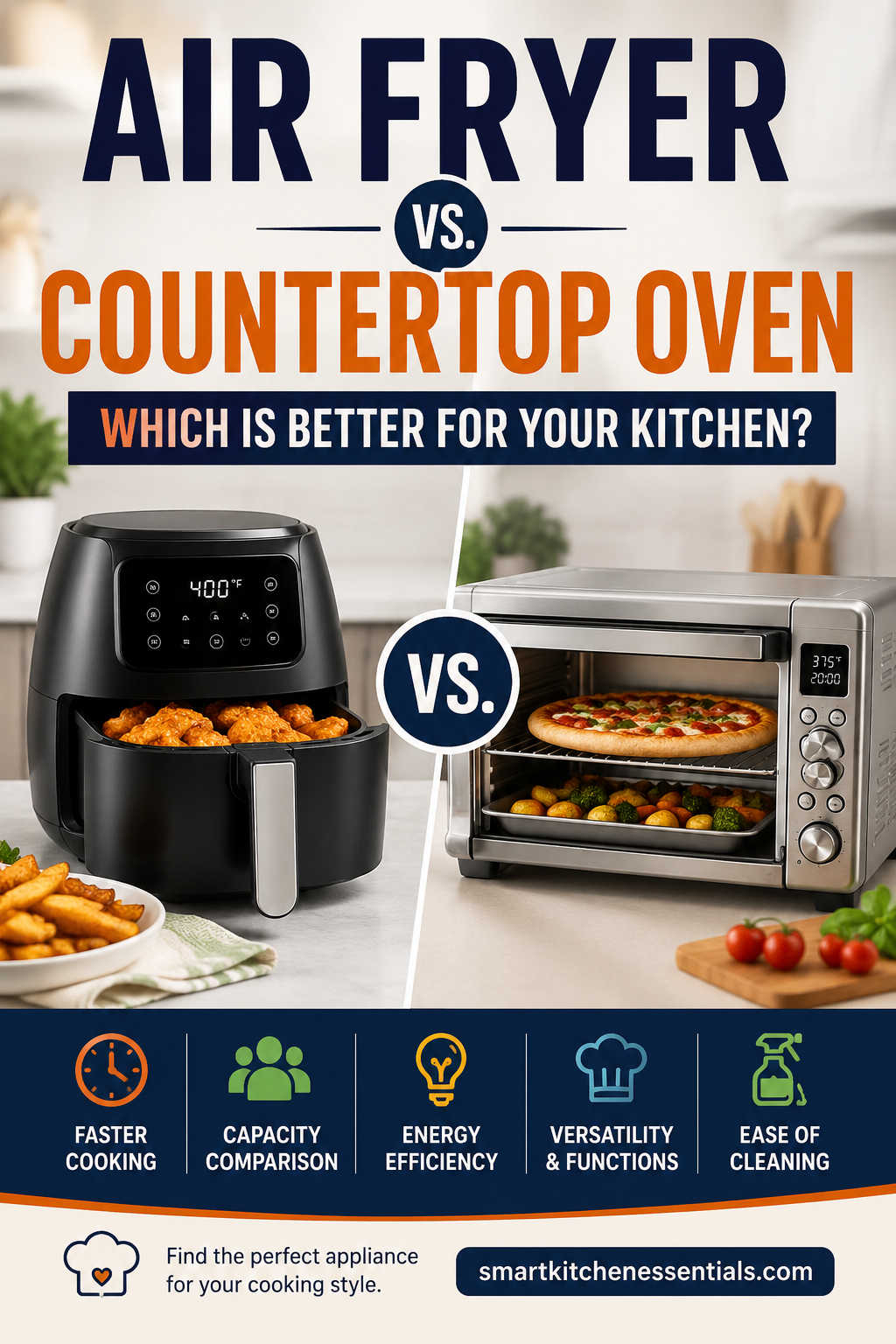
Choosing between an air fryer and a countertop oven isn’t as simple as picking the newest kitchen gadget. While both appliances use hot air to cook food more efficiently than a traditional oven, they’re designed with different priorities in mind.
An air fryer focuses on speed and crispiness, making it a favorite for quick meals and healthier versions of fried foods. A countertop oven, on the other hand, offers greater versatility, allowing you to bake, roast, broil, toast, and often air fry in a single appliance.
If you’re trying to decide which one deserves a spot on your countertop, this guide compares their cooking performance, versatility, energy use, capacity, maintenance, and overall value. By the end, you’ll have a clear understanding of which appliance better fits your cooking habits and household.
Understanding the Difference Between an Air Fryer and a Countertop Oven
Although they share some similarities, these appliances are built for different cooking experiences.
An air fryer uses a powerful fan to circulate extremely hot air through a compact cooking chamber. Because the space is small, the hot air reaches the food quickly and evenly, producing a crispy exterior with very little oil. This rapid air circulation is what gives air-fried foods their signature texture.
A countertop oven functions much like a conventional oven but in a smaller format. Depending on the model, it can bake, roast, broil, toast, warm, and sometimes dehydrate or air fry. The larger cooking cavity makes it more adaptable for preparing a wider range of meals, especially when cooking for several people.
Understanding these design differences helps explain why each appliance excels in different situations.
Cooking Performance: Which Delivers Better Results?
Cooking performance depends largely on the type of food you’re preparing.
Air Fryers Shine With Crispy Foods
If your goal is golden fries, crunchy chicken wings, roasted vegetables, or crispy frozen snacks, an air fryer usually produces the better result.
The rapid airflow continuously moves hot air around the food, helping moisture escape while creating a crisp outer layer. Because the cooking basket exposes more surface area to circulating air, foods brown more evenly than they often do in a traditional oven.
This makes air fryers particularly well suited for foods that would normally be deep-fried.
Countertop Ovens Offer Greater Flexibility
Countertop ovens may not always match the crispiness of a dedicated air fryer, but they handle a much wider variety of recipes.
They’re excellent for baking cookies, roasting meats, reheating leftovers without making them soggy, preparing casseroles, and cooking homemade pizzas. Many newer convection countertop ovens also include an air fry mode that narrows the performance gap.
If you enjoy experimenting with recipes beyond quick snacks and frozen foods, a countertop oven provides considerably more cooking options.
Speed and Convenience
One of the biggest reasons people buy an air fryer is its ability to cook meals quickly.
Because the cooking chamber is compact, it heats almost immediately and usually requires little or no preheating. Many meals finish several minutes faster than they would in a countertop or conventional oven.
Countertop ovens still cook efficiently, especially convection models, but their larger interior naturally takes longer to preheat and maintain cooking temperatures. While the difference isn’t dramatic for larger meals, it becomes noticeable when you’re preparing a single serving or a quick lunch.
For busy weeknights or last-minute meals, the faster cooking time of an air fryer can make everyday cooking more convenient.
Capacity: How Much Food Can Each Appliance Cook?
Capacity is often the deciding factor for families.
An air fryer works best for one or two people, although larger basket and dual-zone models can comfortably prepare meals for three or four. Even then, overcrowding the basket reduces airflow, which can prevent food from browning evenly.
This happens because hot air needs room to circulate around each piece of food. When ingredients are packed too closely together, steam becomes trapped instead of escaping, leading to softer textures instead of the crisp finish most people expect.
Countertop ovens avoid this limitation by offering much more cooking space. Many models can roast an entire chicken, bake multiple trays of cookies, or cook a large pizza without compromising airflow.
If you regularly cook for a family or entertain guests, the additional capacity quickly becomes a practical advantage.
Baking, Roasting, and Everyday Cooking
Although air fryers can bake small cakes, muffins, and brownies, baking isn’t where they truly excel.
Their compact baskets limit pan sizes, making them less practical for larger desserts or multiple servings. Temperature fluctuations caused by the strong fan can also affect delicate baked goods that rely on gentle, even heat.
Countertop ovens create a more traditional baking environment. Their larger cooking cavity allows cakes, breads, pastries, casseroles, and roasted meats to cook more evenly.
If baking is part of your regular routine, a countertop oven is generally the better long-term investment.
Energy Efficiency and Electricity Usage
Both appliances are more energy-efficient than heating a full-size oven, but the better choice depends on how you cook.
Air fryers typically consume less electricity because they heat a smaller space and complete cooking cycles more quickly. If you’re preparing individual meals or small portions every day, you’ll likely notice lower energy consumption over time.
Countertop ovens use more electricity during each cooking session because they heat a larger interior. However, they become more efficient when cooking larger meals that would otherwise require several batches in an air fryer.
Instead of focusing solely on wattage, consider how many cooking cycles you’ll need. One larger countertop oven session may use less total energy than running an air fryer three separate times.
Ease of Cleaning and Maintenance
Cleaning is another area where the differences become apparent after daily use.
Most air fryer baskets feature non-stick coatings and removable trays that are dishwasher safe. Cleaning usually involves washing the basket and wiping down the interior after cooking.
Countertop ovens require slightly more maintenance. Crumbs collect beneath the cooking racks, grease can build up on the interior walls, and heating elements may require occasional cleaning to maintain performance.
Regular cleaning isn’t just about appearance. Built-up grease can create smoke during cooking and reduce heating efficiency over time. Wiping spills soon after the appliance cools makes deep cleaning much easier later.
Regardless of which appliance you choose, routine maintenance helps extend its lifespan and keeps cooking results consistent.
Counter Space and Kitchen Storage
Kitchen size plays a bigger role than many shoppers expect.
Air fryers generally occupy less countertop space and are easy to store inside a cabinet when not in use. This makes them particularly attractive for apartments, dorm rooms, and smaller kitchens.
Countertop ovens require a larger permanent footprint and additional clearance for ventilation. If your kitchen already has limited workspace, finding room for a larger oven can be challenging.
Before purchasing either appliance, measure your available counter space and remember to account for door clearance and ventilation requirements.
Air Fryer vs. Countertop Oven: Side-by-Side Comparison
| Feature | Air Fryer | Countertop Oven |
|---|---|---|
| Cooking Speed | Excellent | Very Good |
| Crispy Foods | Excellent | Very Good |
| Baking | Good for small portions | Excellent |
| Roasting | Very Good | Excellent |
| Toasting | Limited | Excellent |
| Capacity | Small to medium | Medium to large |
| Energy Efficiency | Excellent for small meals | Better for larger meals |
| Counter Space | Compact | Requires more space |
| Cleaning | Easy | Moderate |
| Best For | Quick everyday cooking | Versatile meal preparation |
Common Cooking Mistakes and How to Avoid Them
Even the best appliance can produce disappointing results if it’s used incorrectly.
One of the most common mistakes with an air fryer is overcrowding the basket. This restricts airflow, preventing food from crisping properly. Cooking in smaller batches allows hot air to circulate freely, creating more even browning.
Skipping preheating can also affect cooking consistency. While some recipes don’t require it, preheating helps stabilize the cooking temperature, especially when preparing foods that rely on crisp exteriors.
With countertop ovens, incorrect rack placement is a frequent issue. Food positioned too close to the heating elements may brown before the center finishes cooking. Adjusting the rack based on whether you’re baking, broiling, or roasting helps achieve more even results.
Another overlooked problem is failing to clean grease buildup. Residue left inside either appliance can create unpleasant smoke and interfere with airflow, reducing cooking performance. Regular cleaning keeps temperatures consistent and prevents unwanted flavors from transferring between meals.
Which Appliance Is Better for Different Types of Home Cooks?
Rather than asking which appliance is objectively better, it’s more useful to consider which one matches your lifestyle.
An air fryer is an excellent choice for individuals, couples, students, or anyone who values fast cooking and enjoys crispy foods with minimal oil. It simplifies everyday meals without requiring much kitchen space.
A countertop oven is better suited for families, frequent home bakers, and anyone who prepares larger meals on a regular basis. Its versatility makes it capable of replacing several smaller appliances while handling a broader variety of recipes.
Some households ultimately find that owning both appliances offers the most flexibility. The air fryer handles quick weekday meals, while the countertop oven takes over for baking, roasting, and holiday cooking.
Should You Buy a Countertop Oven With an Air Fry Function?
Many modern countertop ovens now include an integrated air fry setting, making them appealing to buyers who want one appliance instead of two.
These models use convection fans to circulate hot air in a similar way to dedicated air fryers. They can produce excellent results for many foods while still offering traditional baking and roasting functions.
However, dedicated air fryers often generate slightly crispier textures because their cooking chamber is smaller and airflow is more concentrated. If crispy fries, wings, and frozen snacks are your primary focus, a standalone air fryer still holds a slight performance advantage.
On the other hand, if you prefer an appliance that can bake bread one day and roast vegetables the next, a countertop oven with an air fry mode may provide the better overall value.
Is It Time to Upgrade or Replace Your Current Appliance?
If your existing appliance no longer heats evenly, takes significantly longer to cook than it once did, or struggles to maintain temperature, replacing it may improve both cooking quality and energy efficiency.
Upgrading also makes sense if your cooking habits have changed. Someone who has started cooking for a larger family may outgrow a compact air fryer, while someone living alone may discover that a full-size countertop oven feels unnecessarily large for everyday meals.
Rather than choosing the newest model with the most features, focus on how you actually cook. The best appliance is the one that fits your kitchen, your routine, and the types of meals you prepare most often.
Final Thoughts
Both air fryers and countertop ovens offer clear advantages, but neither is the perfect choice for every household.
If your priorities are speed, crispy results, lower energy use for small meals, and a compact appliance, an air fryer is difficult to beat. It excels at preparing everyday favorites quickly while using little oil.
If you need greater cooking capacity, enjoy baking, or want one appliance that can handle everything from toast to roasted dinners, a countertop oven is the more versatile option.
Before making your decision, think about how many people you typically cook for, the recipes you prepare most often, and the amount of space available in your kitchen. Matching the appliance to your real-world cooking habits will provide far more satisfaction than simply choosing the one with the longest feature list.
Whether you decide on an air fryer, a countertop oven, or a model that combines both functions, understanding the strengths and limitations of each appliance will help you cook more efficiently and enjoy better results every time.